A note on volatility, for the long horizon investor
A short reframe of equity volatility for investors with a horizon measured in decades, not quarters. What to read less of, and what to trust more.
Every few quarters, the equity market produces a stretch that is genuinely uncomfortable to live through. Headlines turn sharp. Group chats fill with charts. A friend who has never spoken to you about markets asks, casually, whether you think this is the start of something serious.
We want to offer a short reframe, written for the investor whose real horizon is measured in decades, not quarters. If your horizon is shorter, almost nothing below applies, and you should be having a different conversation with your advisor.
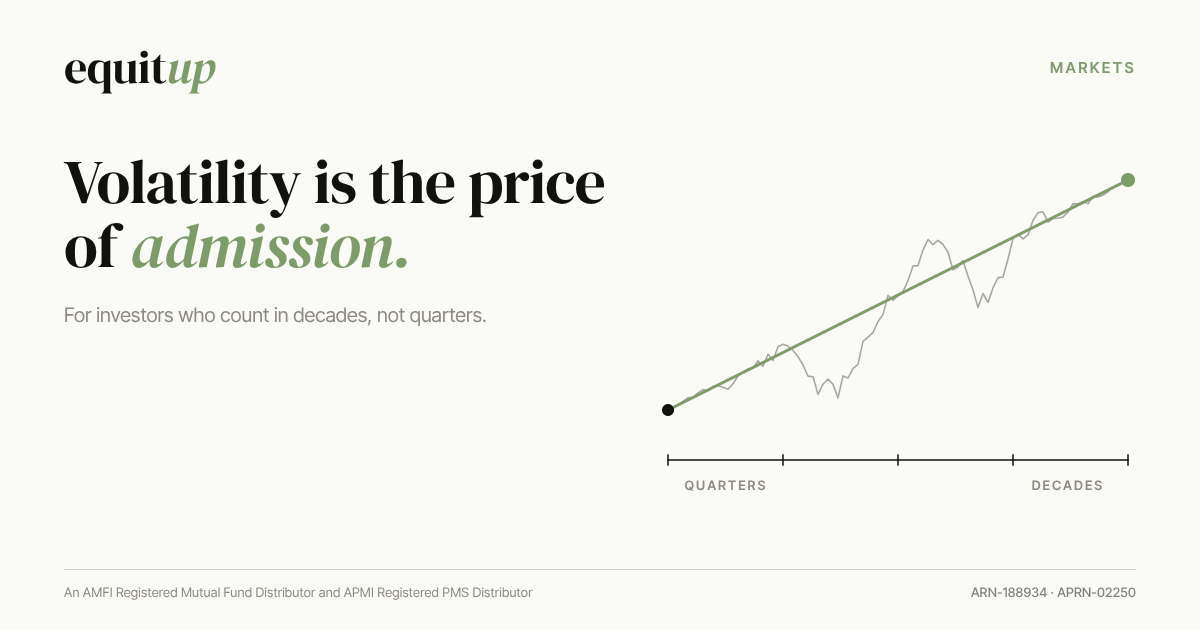
Volatility is the price of admission
Long horizon equity returns are not free. They are paid for in stretches of discomfort, distributed irregularly across the holding period. If you remove the discomfort, you remove the return. We have not yet found a serious exception to this rule.
This is not a slogan. It is the actual mechanism. Equity is the most junior claim on a business. In good years it absorbs the upside that bondholders do not get. In hard years it absorbs the fear that bondholders do not have to feel. Over long periods, the trade has historically paid. Over short periods, it can do almost anything.
Three habits that quietly help
We are wary of long lists. Three habits, kept consistently, do more than a dozen kept occasionally.
- Read less during difficult months, not more. The volume of market commentary expands precisely when its average quality declines. The signal does not get stronger when the noise does.
- Trust the allocation you set in calm weather. It was not built for the calm weather. It was built, in part, for the weather you are in right now.
- Notice the temptation to act. Then choose, deliberately, whether to act on it. The choice itself is most of the work.
What to do with the urge to do something
The urge is real and usually well intentioned. You want to protect what you have. You want to feel that you are responding to the situation. These are not flaws. They are how careful people are wired.
A small ritual we suggest: when the urge appears, write down what you are tempted to do, why, and what you expect the outcome to be. Date it. Put it in a drawer. Read it again in twelve months. The exercise is humbling, and humility is the most underrated input to a long horizon return.
If, after writing it down, you still want to act, call your advisor before you trade. Not for permission. For a conversation. Most of the time, the act of saying the plan out loud is enough to change it.
Drawdowns are not the same as losses
A drawdown is a paper movement of the price at which you could sell today. A loss is what you book when you actually sell. These are not the same thing, and treating them as the same is the most expensive cognitive error in our work.
The plan, set in calm weather, told you that you would not need this money for a long time. That plan did not change because the price did. If anything, the price moving down has made future expected returns from the same investment somewhat better, not worse, for the long holder who is still adding.
Rebalancing, not reacting
For families who follow a written allocation, hard months are usually rebalancing opportunities. Not heroic ones. Routine ones. If your target was sixty percent equity and you are now at fifty four percent because equity fell, the mechanical answer is to top up, in line with your plan, to bring the allocation back toward target.
This is not bravery. It is bookkeeping. Done over many cycles, it is one of the quietly most valuable behaviours in a long horizon portfolio.
Two things we will not promise
We will not promise that you will not see further drawdowns. We will not promise a number for what equity returns over any specific period. Anyone promising either is selling something we would not buy.
What we will say is this. Over the holding periods that actually matter for the goals you have told us about, your plan has been built with these stretches in mind. The plan does not work because the weather is good. The plan works because it has been designed for the weather to occasionally be bad.
A closing note
None of what we have written is new. We repeat it, plainly, because the things worth saying about investing are not numerous and they bear repeating. If this note is the most boring thing you read about markets this month, we will consider it to have done its job.
Mutual fund investments are subject to market risks. Read all scheme related documents carefully.