After the exit: the first 90 days
A letter to founders and senior operators on what to do, and what to deliberately not do, in the first three months after a meaningful liquidity event.
We write this for the founder or senior operator who has just had a meaningful liquidity event. The wire has cleared. The thank you notes are out. The phone has, somehow, started ringing more, not less.
This is a letter, not a plan. The plan comes later, in long conversations with people who know your family. What we want to offer here is a frame for the first ninety days, so that the decisions you make in week one are not the ones you regret in year three.
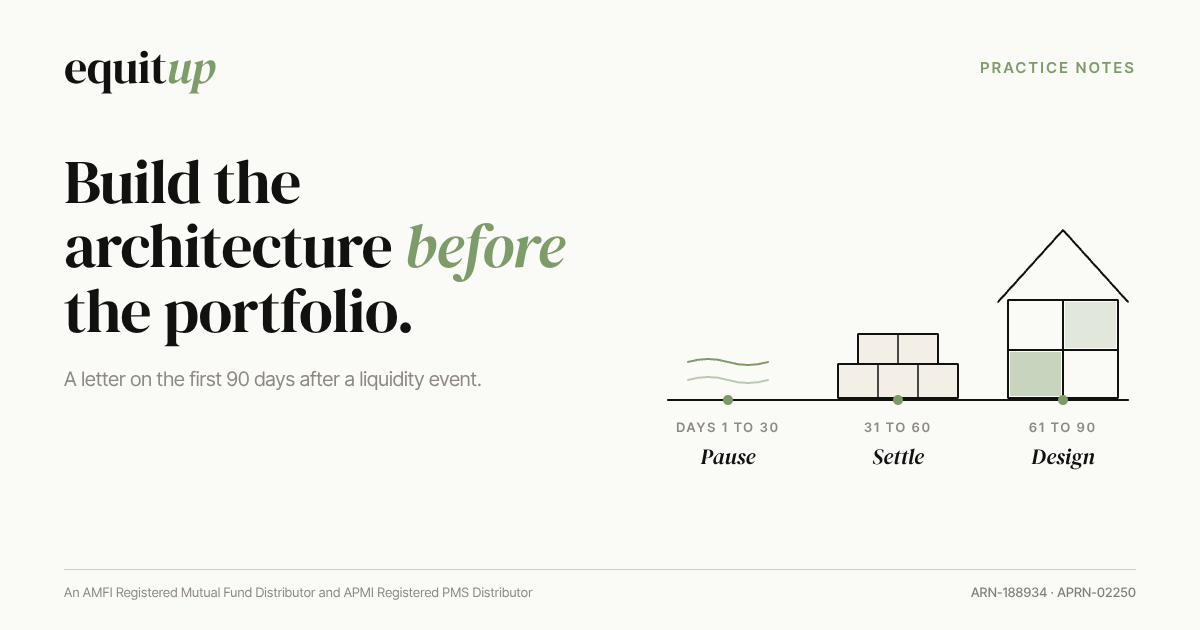
Days 1 to 30: do almost nothing
The first month is for absorption, not action. The instinct after a liquidity event is to deploy. Friends will send decks. Wealth managers will appear in your inbox. A real estate broker will mention, in passing, that a building has come on the market.
For thirty days, decline politely. Park the proceeds in a boring, fully liquid, capital protected vehicle. A government securities money market fund, a sweep account, an overnight liquid fund. The yield is unimportant. The job of this money, for now, is to sit still.
Use the month to do four quiet things.
- Write down what the exit means for your family, in your own words, on one page. Not numbers. Meaning. What changes, what does not, what you want it to make possible.
- List your obligations: taxes due, debts to be retired, commitments already made.
- List the people you want to involve in the decisions to come. Your spouse, certainly. A trusted CA. A lawyer for the estate work. A financial partner. Keep the list small.
- Notice what you feel. Relief, restlessness, guilt, anticipation. All of these are common. None of them is a basis for an investment decision.
Days 31 to 60: settle the foundations
In the second month, do the unglamorous work that everyone postpones.
Pay the taxes properly. Have your CA model the exact liability under each available structure. Pay what is owed, on time, and document everything. Tax shortcuts are not, in our experience, a place where smart people add value.
Retire expensive debt. Personal loans, credit card balances, any borrowing that costs more than a fair fixed deposit yields. This is not financial engineering. It is hygiene.
Refresh the basics. A will, updated. Beneficiary nominations on every account, current. Term life and health cover, sized for the life you actually live now, not the one you lived when you signed up. Power of attorney documents, in case. None of this is exciting. All of it matters.
Set a spending rule for the next twelve months. Not a budget in the punitive sense. A rule. For example: total household outflow stays within X percent of pre exit levels for one year, while the rest of the picture takes shape. The rule is a gift to your future self, who will otherwise drift.
Days 61 to 90: build the architecture
By the third month, you are ready to think about the long horizon. Not invest yet, but design.
Decide, with your financial partner, what the money is for. A specific number of years of family expenses, held safely. A long horizon growth pool. A bucket for the next venture, if you want one. A philanthropic allocation, if that is part of your life. Each of these has a different job, a different time horizon, and a different acceptable level of fluctuation.
Decide what fraction of the proceeds you are willing to commit to illiquid assets, including private deals from friends. We suggest a ceiling, in writing, that you can revisit yearly. Without one, the ceiling tends to be set by whichever pitch you heard most recently.
Decide what you will not do. A "no" list is more valuable than a "yes" list at this stage. Common entries: no investments in businesses you cannot evaluate, no personal loans to acquaintances, no commitments larger than X without a week of reflection, no concentrated bets larger than Y percent of the family balance sheet.
The deployment itself can be slow
Once the architecture is set, the deployment can take six to eighteen months, in stages. There is no prize for getting fully invested in week thirteen. There are real penalties, paid in regret, for getting fully invested before you have decided what you are invested for.
We stage deployments across cash, debt, and equity in tranches, with a fixed calendar, regardless of where markets are on any given Tuesday. This is not market timing. It is humility, expressed as a schedule.
A note on identity
The hardest part of the first ninety days is often not the money. It is the gap between who you were last quarter and who the world now thinks you are. You will be asked to be on boards, to speak on panels, to fund things, to mentor people.
Some of these will be wonderful. Some will be quiet drains on the time you wanted to spend with your family, or on whatever comes next for you. The same caution applies as with the capital. Do less in the first ninety days than you think you should. The opportunities that matter will still be there in month four.
What we would tell our own family
If our brother or sister had just had a liquidity event, we would say the same three things.
- Move the money somewhere safe and boring, today.
- Take a month before you decide anything.
- Build the architecture before you build the portfolio.
The rest is detail, and detail is what the next conversation is for.
Mutual fund investments are subject to market risks. Read all scheme related documents carefully.