The tech professional's guide to RSUs and Indian taxes
How RSUs are taxed in India: vesting taxed as salary, capital gains on sale, the 24 month rule for foreign shares, and 12.5 percent LTCG, explained simply with a calculator.
If you work for a multinational tech company or a fast growing startup, there is a high chance your compensation package includes Restricted Stock Units (RSUs). Having company stock is an incredible way to build wealth, but the tax rules surrounding foreign shares can feel like a complicated maze.
Let's cut through the jargon and break down exactly how RSUs are taxed in India, using simple math.
What is an RSU
Imagine your company hands you a locked treasure chest as a reward for your hard work. The catch? They won't give you the key until you stay with the team for a certain amount of time. That is the essence of an RSU.
There are three big milestones you need to know:
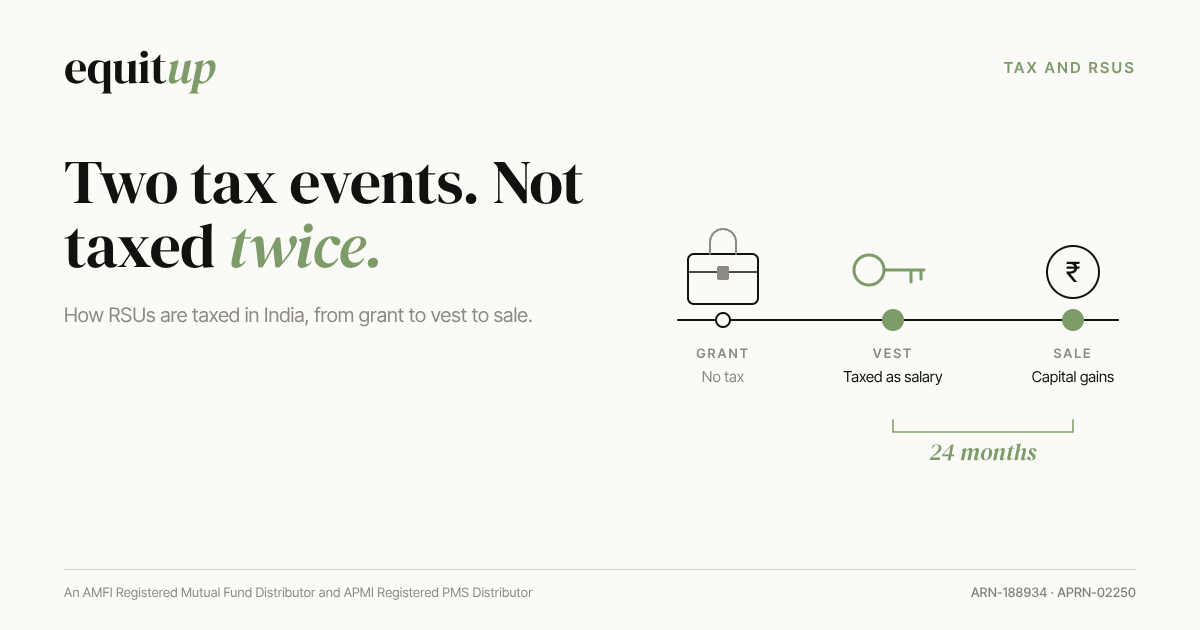
The Grant Date (The Promise): This is the day they hand you the locked chest. You haven't paid anything for it, and you cannot open it yet. Tax impact: zero. The Indian income tax department ignores this event.
The Vesting Date (The Key): You hit your one year work anniversary! The company hands you the key, the restrictions vanish, and the shares legally become yours.
The Sale Date (The Cash Out): The day you decide to sell your shares on the stock market to get liquid cash.
When are RSUs taxed in India
The most common question professionals ask is: "Why am I taxed twice?" The truth is, you aren't taxed on the same money twice; you are taxed on two different events.
Tax at vesting: treated as salary
The moment your RSUs vest, the government looks at the total value of those shares and treats it exactly like a cash bonus.
If your shares are worth ₹10 lakhs on the day they vest, that ₹10 lakhs is added straight to your taxable salary for the year. You will owe tax on it according to your income tax slab (often 30%).
How do you pay it? Most global companies use a "Sell to Cover" method. They automatically sell enough of your newly vested shares to pay the taxman on your behalf, depositing the remaining shares into your demat account.
Tax at sale: capital gains on foreign shares
Let's say you hold onto those remaining shares, and the company's stock price goes up. A year later, you sell them to buy a house. You only pay tax on the new profit you made between the Vesting Date and the Sale Date.
The 24 month rule and 12.5 percent LTCG
Because foreign shares (like US tech stocks) are considered "unlisted" in India, the holding period rules are strict:
Short Term (sold within 24 months of vesting): your profit is considered a Short Term Capital Gain (STCG) and is taxed at your normal income tax slab rate.
Long Term (sold after 24 months of vesting): you are rewarded for holding! Under the latest tax rules, your profit is considered a Long Term Capital Gain (LTCG) and is taxed at a flat 12.5% (without indexation).
To make this completely clear, try adjusting the numbers in the calculator below to estimate how these two tax events play out.
Adjust the inputs to see how the two tax events change. Results update live.
Indicative only, for education. Surcharge and cess not included. Consult a chartered accountant for your filing.
What to do with the cash after you sell
Navigating the vesting schedules and cashing out your RSUs is only half the battle. Once you sell, you are left with liquid cash sitting in your bank account. Leaving it idle means losing purchasing power to inflation.
This is where the focus shifts from earning wealth to growing it. Whether your goal is building a diversified equity portfolio to outpace inflation, balancing risk through debt funds, or simply ensuring your hard earned wealth isn't sitting lazy, finding the right pathway is the critical next step.
If you'd like to think through what comes after the sale, that's a conversation we have with tech professionals every month. Begin one here.
Common questions
Are RSUs taxed twice in India?
No. You are taxed on two separate events, not twice on the same money. At vesting, the value of the shares is taxed as salary income at your slab rate. At sale, only the profit made after vesting is taxed as capital gains.
What is the holding period for US stocks for long term capital gains in India?
24 months from the vesting date. Foreign shares are treated as unlisted in India, so selling within 24 months means short term gains taxed at your slab rate, and selling after 24 months means long term gains taxed at a flat 12.5 percent without indexation.
Is sell to cover taxable in India?
The shares sold under sell to cover are part of your vesting, which is already taxed as salary. If those shares are sold at the same price at which they vested, there is typically no additional capital gain on them. Your remaining shares carry the vesting price as their cost basis for future capital gains.
Mutual fund investments are subject to market risks. Read all scheme related documents carefully.