The ultimate cheat sheet: SIP, STP, SWP and Lumpsum explained
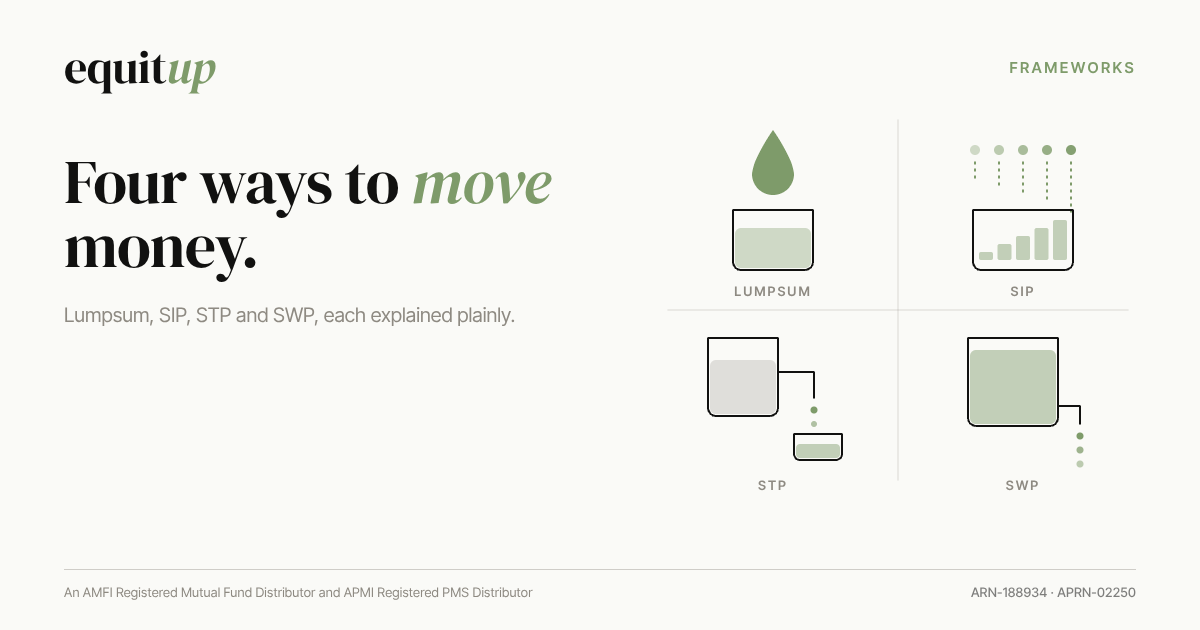
The four ways to move money in mutual funds: SIP, STP, SWP and lumpsum, explained with simple analogies and an interactive strategy simulator.
When you first start earning, the world of investing feels like a completely different language. Everyone is throwing around acronyms like SIP, STP, and SWP, and you are just sitting there wondering what to do with the excess cash left in your account at the end of the month.
Getting into mutual funds is actually a lot like managing your everyday recurring subscriptions and expenses. Let's break down the four ways you can move your money in the market, using simple analogies that make sense.
Lumpsum: the one time investment
What it is: You take a large chunk of money and invest it into a mutual fund all at once.
The analogy: It's like buying a premium gadget outright in cash. You drop the money once, and you own the asset fully.
The typical use case: You just received an annual performance bonus at work, an inheritance, or a maturity payout from an old insurance policy. If you do not need this money in the short term, you deploy it into a mutual fund as a single transaction and allow it to compound over a multi year horizon.
SIP: the automated monthly contribution
What it is: You invest a fixed, smaller amount of money every single month on a predefined date.
The analogy: It's exactly like an entertainment subscription or a utility bill, but instead of paying a service provider, you are systematically paying your future self.
The typical use case: This is the foundation of wealth building for salaried professionals. Once your income is credited at the start of the month, a fixed portion automatically moves via an ECS mandate into an equity mutual fund. It helps you invest consistently without trying to time the market's daily ups and downs.
STP: the drip feed strategy
What it is: You park a large sum of money in a relatively stable, low risk fund (like a liquid or debt fund). Then, you instruct the mutual fund company to automatically transfer a specific fixed amount every month into a higher potential growth fund (like an equity fund).
The analogy: Imagine you have a large water reservoir. Instead of dumping all the water onto a delicate plant at once and risk drowning it, you set up a drip irrigation line that feeds the roots a steady amount over an extended period.
The typical use case: Suppose you have a significant lump sum from a property sale or stock liquidation. You want to invest it in equity, but you are concerned about near term market volatility. An STP keeps your core capital secure while systematically transitioning into the equity market to average your purchase costs over time.
SWP: the automated income route
What it is: You have a substantial corpus already accumulated within a mutual fund. Instead of adding to it, you instruct the fund to automatically redeem and transfer a fixed amount into your bank account every month. The remaining balance stays invested and continues to compound.
The analogy: It's like owning a commercial property. You maintain full ownership of the building (your capital corpus), while collecting a regular monthly rent check (your SWP check) generated by the asset.
The typical use case: While commonly utilized during retirement to replace regular salary income, an SWP is also ideal for professionals taking a career sabbatical, transitioning into entrepreneurship, or funding higher education, providing a reliable cash flow while keeping the underlying investment active.
Try the simulator below to see how each of these four strategies plays out with your own numbers.
Pick a strategy and adjust the inputs. Results update live.
Returns shown are your own assumption, not a projection. Mutual fund investments are subject to market risks. For education only.
Ready to start your financial engine?
At Equitup, the goal isn't just to explain how these mechanisms work; it's to help you find the strategy that fits your situation. Whether you are setting up a disciplined monthly SIP or moving a large lump sum gradually through an STP, the right framework matters.
Have questions about which mode suits you? Begin a conversation here.
Common questions
What is the difference between SIP and STP?
A SIP moves money from your bank account into a fund every month. An STP moves money from one fund to another every month, typically from a low risk fund where a lump sum is parked into an equity fund. SIP is for investing fresh income; STP is for deploying a lump sum gradually.
Is an SWP the same as withdrawing my investment?
Not quite. A full withdrawal ends the investment. An SWP redeems only a fixed amount each month while the rest of the corpus stays invested and continues to compound, which is why it is often used to create a regular cash flow.
Can I stop or change a SIP, STP, or SWP once started?
Yes. All three are instructions, not lock ins. They can be paused, modified, or stopped, although some schemes may carry exit loads or minimum durations, which are stated in the scheme documents.
Regulatory disclosure: Equitup Financial Services LLP · AMFI Registered Mutual Fund Distributor · ARN-188934. APMI Registered PMS Distributor · APRN-02250. The information in this article is intended strictly for educational purposes to illustrate operational mechanisms of mutual funds. It does not constitute personalized financial, investment, legal, or tax advice.
Mutual fund investments are subject to market risks. Read all scheme related documents carefully.